Royal Dental College
E-ISSN: Coming Soon
E-ISSN: Coming Soon
Antifungal activity of different types of honey against oral Candida albicans isolates
Full Html
Introduction
Honey has been used by mankind since ancient times due to its potent medicinal properties in treating wide ranges of ailments.[1] Most commonly this has been used to treat small lesions on skin and oral infections owing to its antimicrobial efficacy and better healing process.[2] Honey is a natural complex and is made up of 3 types of volatile compounds: terpenes, nor isoprenoids and benzene derivatives. These volatile oils represent a finger print of a specific honey and is frequently used differentiate between monofloral honey and multifloral honey. This also helps in identifying the botanical geographic origin of honey.[3] The effectiveness of hone has been associated to its biological properties, such antimicrobial, anti-inflammatory, tissue repairing, and debridement of wounds. Moreover, the antimicrobial property of honey is depending on the floral sources, processing, and the type of honey bee.[4] Candida albicans is the most common opportunistic infection of the oral cavity. It persists as a normal commensal of oral cavity and are in harmony with the other normal flora of oral cavity to maintain healthy immune system. An unbalance niches leads to overgrowth of candida organism leading to oral candidiasis and further requires antifungal medicines for the management. The side effects of antifungals and the emerging resistance of candida to antifungals making the treatment options troublesome. In recent era, modern medicine has rediscovered the therapeutic benefits of honey in the treating wounds, bedsores, and other conditions in hospitalized patients.[5] Many researchers have proved the broad spectrum of antibacterial activity of honey against pathogenic bacteria both gram positive and gram negative and fungi.[6] However, there were no sufficient existing data on antimicrobial property of oral pathogen such as Streptococcus mutants, Enterococcus species, Lactobacillus, Candida albicans etc. Thus, the aim of the present study is to study the antifungal activity of different types of honey against oral Candida albicans isolates.
MATERIALS AND METHODS
This in vitro experimental study was conducted in the Department of Microbiology. Oral swab samples were obtained from healthy dental student volunteers after obtaining informed consent. Ethical clearance for the study was obtained from the Institutional Ethics Committee, and all procedures were carried out in accordance with standard biosafety guidelines. A total of 50 isolates of Candida albicans were included in the study. Oral swabs were collected from the buccal mucosa and dorsum of the tongue using sterile cotton swabs under aseptic conditions. The collected swabs collected from participants were immediately inoculated onto HiChrome Candida Differential Agar (HiMedia Laboratories Pvt. Ltd., India) and incubated aerobically at 37°C for 24 hours. Speciation was performed based on colony color and morphology. Isolates producing green-colored colonies were identified as Candida albicans. All isolates included in the study (100%) exhibited characteristic green pigmentation on HI Chrome agar. The three different types of honey used in the study were commercially available Dabur honey, Khadi honey and honey procured from local vendor. All honey samples were stored in sterile containers at room temperature until further use. The Minimum Inhibitory Concentration (MIC) of all 3 types of honey was estimated by using agar dilution method was employed to determine determine the Minimum Inhibitory Concentration (MIC) of the three honey samples against Candida albicans isolates under aseptic conditions. Honey dilutions ranging from 5% to 25% (v/v) were prepared using sterile distilled water and incorporated into molten Sabouraud Dextrose Agar (HiMedia, India). The agar was poured into sterile Petri plates and allowed to solidify. Each isolate was spot inoculated onto plates containing different concentrations of honey and incubated aerobically at 37°C for 24–48 hours. Growth control plates without honey was also included. The MIC was defined as the lowest concentration of honey that completely inhibited visible growth of the isolate. The MIC values obtained for the three types of honey were recorded and tabulated. Data were entered into Microsoft Excel and analyzed using Statistical Package for the Social Sciences (SPSS) software (version XX.0; IBM Corp., Armonk, NY, USA). MIC values were expressed as frequencies and percentages. Comparison of MIC distributions among the three honey samples was performed using the Chi-square test. A p value of <0.05 was considered statistically significant.
RESULTS
In this in vitro study we noted that In Dabur honey, 5 (10%) of isolates were inhibited at 5% of Honey. Whereas, khadi honey has inhibited 7 (14%) of isolates at same 5% of honey which considered as the lowest concentration and MIC values as well. However, other strains were also inhibited at different concentrations of honey in different proportions. Similar kind of studies were also been conducted elsewhere using bacterial isolates. But determining the MIC values of honeys against C. albicans was not reported much. Nevertheless, honey from the local vendor did not inhibit all isolates within 5-25% of honey. Only 13 (26%) and 16 (32%) of them were inhibited at 20% and 25% of local honey respectively. However, the rest of 21(42%) isolates were not even responded at any of these concentrations of honey. In this in vitro study among the 50 Candida albicans isolates tested, with respect to Dabur honey, inhibition of Candida albicans isolates was observed across varying concentrations. At 5% concentration, 5 isolates (10%) were inhibited. At 10% concentration, inhibition was observed in 6 isolates (12%). The highest inhibitory activity was noted at 15% concentration, where 24 isolates (48%) were inhibited. Further, 14 isolates (28%) showed inhibition at 20% concentration, while only 1 isolate (2%) was inhibited at 25% concentration. (Table 1) (Chart 1)
DABUR HONEY | |||||
Conc of honey | 5% | 10% | 15% | 20% | 25% |
No of C albicans | 5 | 6 | 24 | 14 | 1 |
% | 10% | 2% | 48% | 28% | 2% |
Table 1: Distribution of MIC values of Dabur honey against albicans isolates
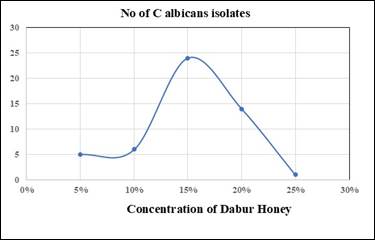
Chart 1: line graph showing no of C albicans against ascending concentrations of Dabur honey
In the case of Khadi honey, inhibitory activity against Candida albicans was observed at varying concentrations. At 5% concentration, 7 isolates (14%) were inhibited, which represented the lowest MIC observed. At 10% concentration, inhibition was noted in 5 isolates (10%). The maximum inhibitory effect was observed at 15% concentration, with 28 isolates (56%) showing inhibition. Further inhibition was seen in 10 isolates (20%) at 20% concentration, while no isolates (0%) were inhibited at 25% concentration. (Table 2) (Chart 2)
KHADI HONEY | |||||
Conc of honey | 5% | 10% | 15% | 20% | 25% |
No of C albicans | 7 | 5 | 28 | 10 | 0 |
% | 14% | 10% | 56% | 20% | 0% |
Table 2: honey Distribution of MIC values of Khadi honey against Candida albicans isolates
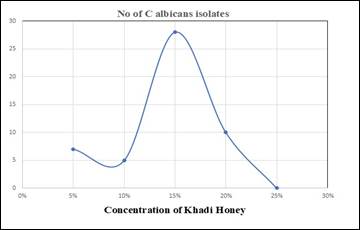
Chart 2: line graph showing no of C albicans against ascending concentrations of Khadi honey
In contrast to the above findings, we noted that honey procured from the local vendor exhibited limited antifungal activity against Candida albicans. No inhibitory effect was observed at 5%, 10%, or 15% concentrations. Inhibition was first noted at 20% concentration, where 13 isolates (26%) were inhibited. At 25% concentration, 16 isolates (32%) demonstrated inhibition. However, 21 isolates (42%) did not show any inhibitory response to local vendor honey at any of the tested concentrations. (Table 3) (Chart 3).
LOCAL VENDOR HONEY | |||||
Conc of honey | 5% | 10% | 15% | 20% | 25% |
No of C albicans | 0 | 0 | 0 | 13 | 16 |
% | 0 | 0% | 0% | 26% | 32% |
Table 3: Distribution of MIC values of local vendor honey against Candida albicans isolates
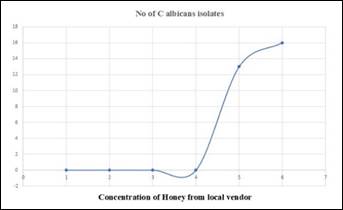
Chart 3: line graph showing no of C albicans against ascending concentrations of local vendor honey
No of C albicans | 5% | 10% | 15% | 20% | 25% |
Dabur honey | 5 | 6 | 24 | 14 | 1 |
Khadi honey | 7 | 5 | 28 | 10 | 0 |
Local vendor honey | 0 | 0 | 0 | 13 | 16 |
Chi-Square test χ² = 76.79, df = 8, p < 0.001* * Statistically significant | |||||
Table 4 showing comparison of No of C albicans against three types of honey concentrations of local honey
Comparison of MIC distributions among the three honey samples demonstrated a statistically significant difference in antifungal activity across concentrations. The Chi-square test revealed a value of χ² = 76.79 with 8 degrees of freedom, and the difference was found to be highly significant (p < 0.001). This indicates that the inhibitory effect against
Candida albicans varied significantly among Dabur honey, Khadi honey, and honey procured from the local vendor at different concentrations.
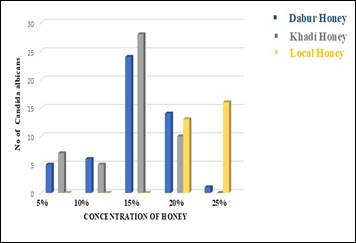
Chart 4 Bar graph depicts the candida isolates inhibited at each concentration for the three types of honey
DISCUSSION
Honey is a complex natural product containing about 200 substances, a complex mixture of sugars with small amounts of other constituents, such as minerals, proteins, vitamins, aroma compounds, organic acids, enzymes, phenolic acids, flavonoids, pigments, waxes, pollen grains and other phytochemicals. Since the 19th century, honey has gained global recognition for its antioxidant, anti-tumor, anti-inflammatory, and antiviral properties.[7] The strongest antifungal activity of honey is production of hydrogen peroxide as a result of glucose oxidation reaction in diluted honey.[8] Methylglyoxal (MGO), bee defensin-1 and other compounds like flavonoids, pheonolic compounds and lysozyme derived from have also been associated with the antifungal effect of honey.[9] Active flavonoids in honey are lipophilic compounds easily penetrate in membranes thus protecting against C albicans. [10] Honey is acidic due to the presence of organic acids in its composition is known to inhibit the growth of various microorganisms with pH in range of 3.2–4.5.[6] Additionally, the osmotic effect of honey should be considered as an intrinsic antifungal mechanism. Indeed, because honey contains a high concentration of carbohydrates and a reduced volume of water, bacterial growth can be inhibited by cell dehydration; this action is more difficult in fungi due to a higher resistance to osmotic pressure.[11] The honey’s action mode, inhibiting the biofilm formation or promoting the disruption of mature biofilm, includes the destruction of the essential components of the organisms of cells, such as the cell membrane integrity and the reduction of the production of an extracellular polysaccharide matrix.[12] It is crucial to recognize that the composition, sensory characteristics, and physical properties of honey are affected by various factors, primarily including its botanical and geographic origins, environmental conditions, the pollen and nectar from the source plant, moisture levels, and the contributions made by beekeepers.Thus, the aim of the study was to assess the antifungal efficacy of different types of honey on C albicans isolates form oral cavity. The present study contributes to existing literature by highlighting the variable inhibitory potential of different honey samples against C. albicans.The present study evaluated the antifungal efficacy of three different honey samples; Dabur honey, Khadi honey, and honey procured from a local vendor against Candida albicans isolates using the agar dilution method. The findings demonstrated a statistically significant variation in the inhibitory activity of the tested honeys (p < 0.001), indicating that the antifungal potential of honey is influenced by its source and composition. Among the three honey samples, Dabur and Khadi honey exhibited superior antifungal activity when compared to the local vendor honey. Both commercial honeys demonstrated inhibitory effects even at lower concentrations (5%), suggesting better and more consistent antifungal properties. The maximum inhibition for both Dabur and Khadi honeys was observed at 15% concentration, inhibiting 48% and 56% of C. albicans isolates, respectively. To the best of our knowledge, we did not come across any study to corroborate this finding. However, we hypothesize that this finding may be attributed to the standardized processing, controlled storage conditions, and relatively uniform phytochemical composition of commercially available honeys. Various literature from the past have suggested the potent antifungal activity of Manuka honey, Agastache honey, Jarrah honey, as they are raw and unprocessed. In contrast, local vendor honey showed limited antifungal activity, with no inhibition
observed at concentrations up to 15%. Inhibitory activity was detected only at higher concentrations (20% and 25%), and notably, 42% of isolates remained uninhibited even at the highest concentration tested. This finding is in contrast to the study by Theun de Groot 2021 who found that local honey had more effective antifungal activity than medical grade honey.[13] The reduced efficacy of local honey may be due to variations in floral source, processing methods, moisture content, or dilution and adulteration, which can significantly influence honey’s antimicrobial properties. This is since the antifungal activity of honey has been attributed to multiple mechanisms, including high osmolarity, acidic pH, hydrogen peroxide production, and the presence of bioactive compounds such as flavonoids and phenolic acids.[14]Thus, the observed differences among the different honeys in the present study suggest that these factors may vary considerably depending on the source and processing of honey. Previous studies have reported antimicrobial effects ofhoney predominantly against bacterial pathogens; however, data regarding its antifungal activity, particularly against Candida albicans remain limited. Top of FormBottom of FormBrady et al 1996 showed that Manuka honey has potent antibacterial activity but a weak antifungal activity suggesting that honey with potent antibacterial activity may not have good antifungal activity.[15] Despite the promising findings, the study has certain limitations. The in vitro design may not fully replicate oral environmental conditions, and only concentration-dependent inhibitory effects were assessed without evaluating fungicidal activity or time-kill kinetics. Further studies incorporating larger sample sizes, physicochemical analysis of honey samples, salivary flow, host immune response, biofilm formation, and in vivo models are warranted to better elucidate the therapeutic potential of honey as an antifungal agent.Forthrightly, conventional antifungals will not disappear any time soon, introduction of natural products as alternatives to treat antifungals helps in preservation of commensalism. It could also make smaller doses of conventional antifungals given over shorter periods of time thus making the management of candidiasis more effective and less harmful.
Conclusion
The results of the present study indicate that commercially available honeys exhibit greater antifungal efficacy against Candida albicans compared to locally sourced honey, and their inhibitory activity varies with concentration. These findings suggest a potential role for standardized honey preparations as adjunctive antifungal agents in oral healthcare, subject to further clinical validation.
References